A missed badge return, an unsecured supply closet, or a cleaner who does not know which conference room is occupied can create problems long before anyone notices a streaked floor. A commercial cleaner onboarding checklist gives facility leaders and cleaning providers a practical way to prevent those gaps before the first shift begins.
For Chicagoland businesses, onboarding is not just an administrative task. It is the point where service expectations, building access, safety requirements, and communication procedures become operational. A cleaner may have strong technical skills, but without clear site-specific direction, quality can vary from shift to shift.
Why a Commercial Cleaner Onboarding Checklist Matters
Commercial spaces are rarely identical. An office with hybrid employees has different needs than a medical practice, warehouse, school, retail location, or multi-tenant property. Occupancy patterns, restricted areas, waste handling rules, floor types, and client-facing expectations all affect the work.
A documented onboarding process turns those details into clear instructions. It also creates accountability for both sides. The facility team identifies what matters most, while the cleaning provider confirms how, when, and by whom each task will be completed.
The result should be more than a list of chores. A useful checklist establishes a repeatable service standard that can be reviewed when staffing changes, schedules shift, or the facility adds new requirements.
Start With the Scope of Work
Before assigning a cleaner to the site, confirm the scope of work in plain language. General terms such as clean restrooms or maintain common areas leave too much room for interpretation. Define the expected outcome, service frequency, priority areas, and any tasks that require approval before completion.
For example, nightly restroom service may include restocking dispensers, disinfecting touchpoints, removing waste, cleaning fixtures, mopping floors, and reporting leaks or damaged hardware. A periodic floor-care service may require different equipment, drying-time controls, and coordination with building occupants.
The scope should also distinguish routine work from as-needed requests. Spill response, post-event cleanup, emergency service, and specialty projects should have a clear request process and response expectation. This is especially valuable for facilities that operate outside standard business hours.
Confirm the Service Schedule
The schedule needs to protect business operations as well as cleaning quality. Identify approved arrival windows, occupied periods, alarm procedures, loading dock access, elevator restrictions, and building rules for after-hours work.
It is also helpful to establish what happens when a normal service window is unavailable. If a meeting runs late, a weather event affects access, or a tenant requests a schedule change, the cleaner should know who can authorize an adjustment. Reliable service depends on clear decision-making, not assumptions.
Complete Site Access and Security Training
Cleaning staff often work in facilities when managers and employees are gone. That makes security training a core part of onboarding, not an afterthought. Each cleaner should understand exactly where they may go, which rooms are restricted, how keys or badges are handled, and who to contact if access fails.
Review the building's entry and exit procedures in person when possible. A written instruction sheet helps, but it cannot replace a walkthrough of alarm panels, service entrances, freight elevators, lockboxes, and sign-in requirements.
A complete security review should cover:
- Badge, key, code, and alarm procedures, including who may receive or return access items
- Restricted areas such as server rooms, executive offices, records storage, laboratories, and tenant suites
- Visitor, vendor, and after-hours entry rules
- Incident reporting for lost credentials, open doors, suspicious activity, property damage, or access failures
Access protocols should be reviewed whenever a cleaner is reassigned, a manager changes, or the building modifies its security system. A process that worked six months ago may no longer reflect the facility's current requirements.
Walk the Facility Before the First Shift
A site walkthrough gives the cleaning team the context that a task list cannot provide. During the walkthrough, identify entrances, restrooms, break rooms, waste collection points, high-touch surfaces, supply storage, water sources, electrical outlets, and approved equipment locations.
This is also the right time to document high-priority presentation areas. In many offices, reception, lobbies, glass entryways, conference rooms, and restrooms shape a visitor's first impression. In industrial or high-traffic settings, safety-sensitive areas and heavy-use restrooms may require the greatest attention.
Ask facility contacts to point out recurring issues. Perhaps a lobby floor shows salt and slush during Chicago winters, a break room needs more frequent attention on certain days, or a conference room must be reset before early meetings. Those details allow the cleaning plan to reflect actual conditions rather than a generic service model.
Identify Materials, Equipment, and Safety Needs
Cleaning products and equipment must match the site. The wrong chemical can damage natural stone, specialty flooring, glass coatings, or sensitive surfaces. The wrong vacuum or floor machine can create noise, trip hazards, or disruption during occupied hours.
Onboarding should confirm approved chemicals, dilution instructions, safety data access, personal protective equipment, and storage procedures. Cleaners should also know where wet-floor signs, spill kits, first-aid supplies, and emergency exits are located.
If the facility has compliance requirements, incorporate them directly into the work plan. Healthcare-adjacent environments, food-service areas, childcare settings, and regulated offices may require more detailed disinfection practices, documentation, or waste procedures. The right approach depends on the building and its use.
Use This Commercial Cleaner Onboarding Checklist
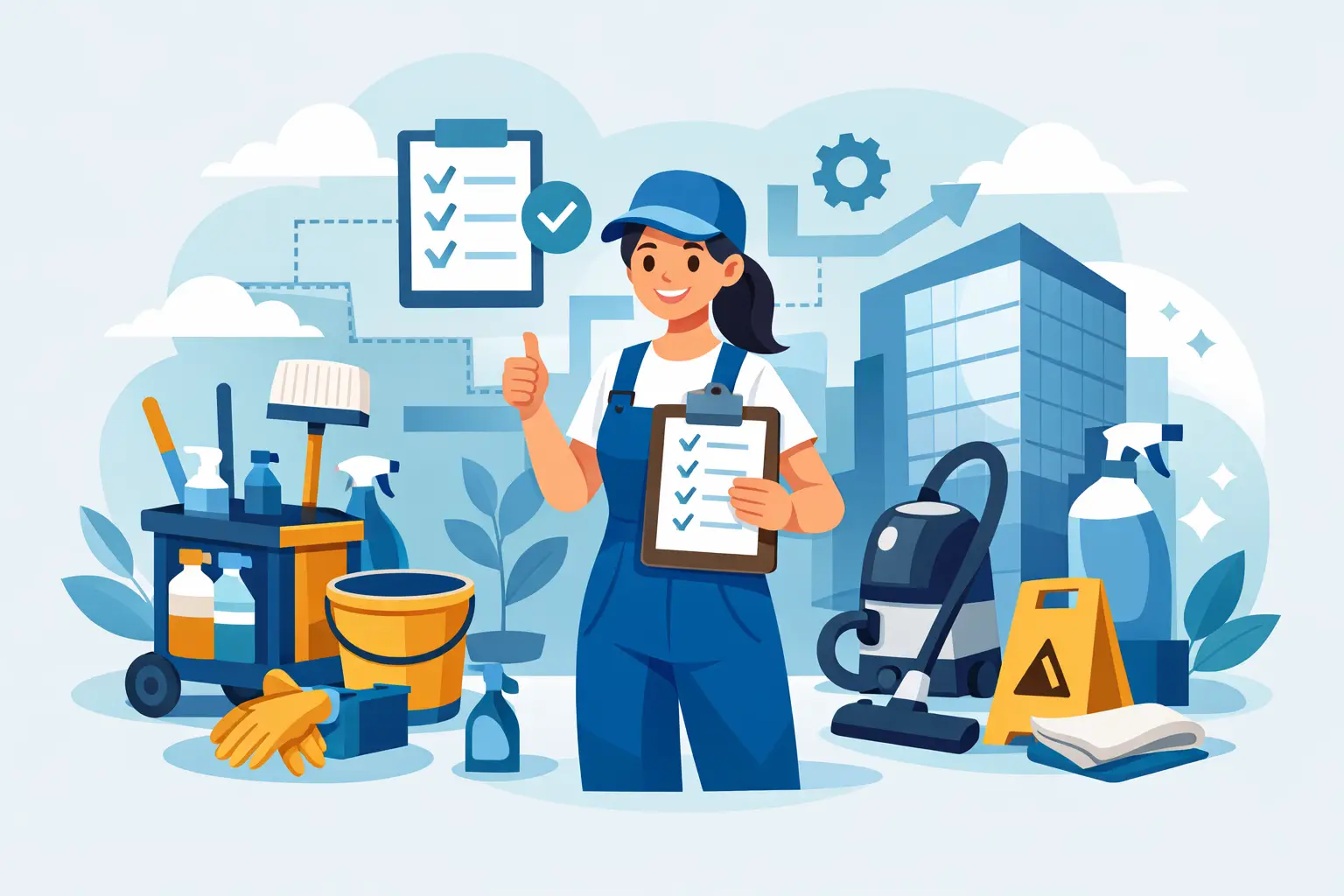
A practical checklist keeps the first shift focused and gives managers a record that training was completed. It should be tailored to each facility, but the following items provide a reliable foundation.
- Verify the cleaner's assigned shift, work areas, supervisor, and primary facility contact.
- Review the written scope of work, room-by-room expectations, service frequencies, and priority tasks.
- Complete a site walkthrough covering entrances, restrooms, common areas, supply rooms, waste routes, restricted spaces, and emergency exits.
- Confirm key, badge, code, lockbox, alarm, and sign-in procedures. Record who issued each access item.
- Review approved cleaning chemicals, equipment, dilution practices, personal protective equipment, and safe storage requirements.
- Explain site-specific hazards, including wet floors, loading areas, elevators, stairs, electrical equipment, sharp waste, and occupied workspaces.
- Identify high-visibility areas, special surfaces, seasonal concerns, and client preferences for presentation and odor control.
- Establish the communication process for supply shortages, quality concerns, damage, spills, missed areas, schedule conflicts, and emergencies.
- Review inspection expectations, including how completed work is documented and how corrective items are handled.
- Confirm the escalation path for issues that cannot be resolved during the shift.
The checklist should be signed or acknowledged by the cleaner and retained by the supervisor. For larger facilities, a site binder or digital operations file can keep current floor plans, task schedules, contacts, and special instructions in one place.
Set Quality Controls During the First Week
The first week is when small misunderstandings become visible. A supervisor or account manager should inspect the work early, ideally after the first few shifts, rather than waiting for a monthly review. Quick feedback gives the cleaner an opportunity to correct expectations before habits are established.
Inspection should focus on results, not only whether a task was attempted. Are restrooms stocked and odor-free? Are high-touch surfaces addressed? Is waste removed correctly? Are floors presentable at the start of the business day? Are supplies organized and secured?
Americlean Professional Services approaches these early reviews as part of building a dependable long-term service relationship. Consistent quality is easier to maintain when concerns are addressed promptly and the service plan can be adjusted as the facility's needs change.
Keep Onboarding Current, Not Static
Onboarding does not end after the first shift. Revisit the checklist when the facility expands, occupancy changes, a tenant moves in, new flooring is installed, or operating hours shift. A new cleaner should receive the same site orientation as the original team, even if the account has been running smoothly for years.
Periodic review also protects against gradual drift. Supply locations change, access codes are updated, and priorities evolve. A short quarterly conversation between the facility contact and cleaning supervisor can catch those changes before they affect service.
A well-run onboarding process gives everyone confidence that the cleaner understands the facility, the standards, and the responsibility that comes with after-hours access. That clarity is where dependable commercial cleaning begins.